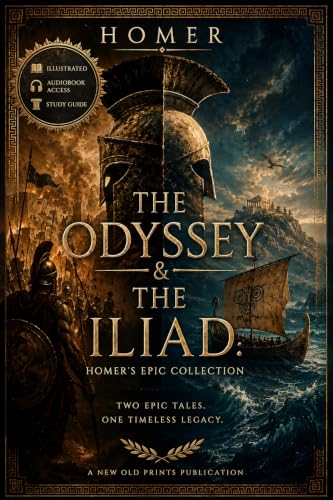
The Odyssey & The Iliad: Homer’s Epic Collection
The complete illustrated and annotated edition of The Iliad and The Odyssey— both epics in one volume with audiobook access.
Table of Contents
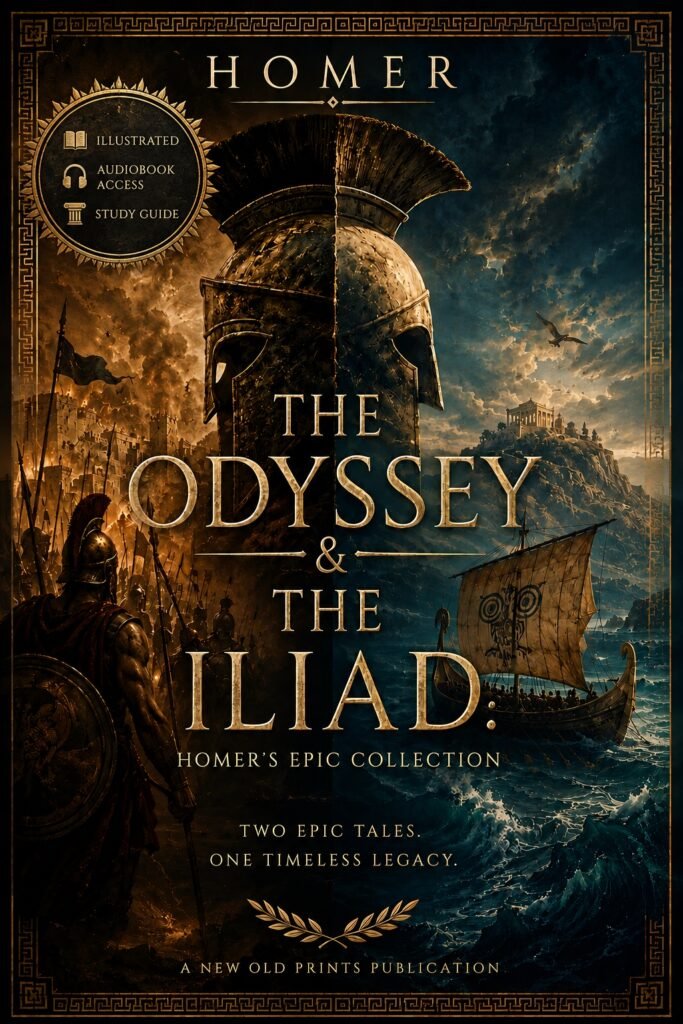
Author: Homer
Translations by: Samuel Butler (1898 Iliad · 1900 Odyssey)
Includes: 10+ original illustrations · Free audiobook links (Iliad & Odyssey) · Study guide · Publisher’s introduction
ISBN (ebook): 979-8-9966554-0-3
ISBN (print): 979-8-9966554-1-0
Available on: Amazon Kindle · Apple Books
About This Edition
The public domain contains Homer’s epics in hundreds of forms — bare text files, plain ebooks, stripped PDFs. What almost none of them contain is anything beyond the words themselves. The New Old Prints Homer’s Epic Collection was built on a different premise: that these are not merely old texts to be preserved, but living stories that deserve to be experienced. That means original illustrations created specifically for this edition. It means scholarly annotations woven through both epics, giving the reader context that the ancient audience would have carried instinctively but the modern reader must be given. And it means a study guide for anyone who wants to sit with these stories long after the last page.
Samuel Butler’s translations were chosen deliberately. His 1898 rendering of the Iliad and his 1900 Odyssey occupy a rare position in the history of English Homer: scholarly enough to be taken seriously by classicists, readable enough to be followed by anyone who simply loves a story. Butler wrote for his contemporaries, and his prose retains a directness and energy that verse translations can obscure. For a modern reader coming to Homer for the first time, Butler’s voice is a reliable guide.
Both epics are collected here in a single volume. Reading them together gives what neither can give alone: the complete arc of the Trojan War, from the rage of Achilles at the siege to the long, god-harried journey home. These are not two separate books that happen to share a world — they are two movements of a single, enormous story, and they belong together.
The Poems
The Iliad
The Iliad is the older of the two epics and in some ways the harder — a war poem set almost entirely on a battlefield, concerned with the nature of glory, mortality, and what men owe each other when civilization is stripped away. At its center is Achilles, the greatest warrior among the Greeks, who withdraws from the fighting after a quarrel over honor and watches his comrades die for it. The siege of Troy is the backdrop, but the subject is grief: what it costs to pursue greatness, and what is lost when the pursuit consumes everything else. The Iliad stands at the foundation of Western literature, and few works in any tradition have matched its emotional ferocity.
The Odyssey
Where the Iliad is concentrated and brutal, the Odyssey sprawls — across seas, islands, years, and the full range of human experience. Odysseus, the cleverest of the Greek heroes, spends ten years trying to return home from Troy. Along the way he faces monsters, gods, storms, temptation, and the particular grief of a man who fears the world has moved on without him. Back in Ithaca, his faithful wife Penelope holds their household together against suitors who assume the king is dead. The Odyssey is a story about endurance, cunning, and the idea that home is worth returning to — and it has never lost its power to move readers who find themselves far from where they belong.
Why Read Homer Now?
Homer’s stories are not survivals from a dead civilization — they are stories that keep being rediscovered because they describe something permanent about how human beings live and what we want. The Trojan War and its aftermath have been retold in every medium and every era because the material is inexhaustible: a conflict born from vanity and honor, a hero who cannot stop fighting, another who cannot stop trying to get home. These tensions do not date. Christopher Nolan’s major film adaptation of the Odyssey, set for release in July 2026, is the latest evidence that Homer’s world continues to pull at the imagination of storytellers working at the highest level — not because it is ancient, but because it is still true.
There is also a more fundamental reason to read Homer: these are the first stories of the Western tradition. The questions the Iliad and Odyssey ask — what makes a life worth living, what we owe the dead, whether cleverness is a virtue or a vice, what home means — are questions that philosophy, literature, and drama have been wrestling with ever since. Reading Homer is not an act of piety toward the classical past. It is going back to the source, and finding that the source is better than most of what has come after it.
What’s Inside This Edition
- Original illustrations throughout both epics
- Scholarly annotations explaining historical and mythological context
- Complete study guide with discussion questions
- Publisher’s introduction and notes
- Samuel Butler’s complete, unabridged translations
- Access to both The Odyssey audiobook and The Iliad audiobook.
Get Your Copy
The Odyssey & The Iliad: Homer’s Epic Collection is available now in ebook and paperback.